
CATEGORY GUIDE 8 min read
Countertop Clutter in 2026: How Retailers Can Build a Better Tea & Coffee Organizer Assortment
Build a tea and coffee organizer assortment for retail: choose formats, confirm countertop fit, review materials and samples, and plan protective packaging.
Why the countertop deserves a focused range
Countertop organization solves a visible, everyday problem. In the IKEA Store & Organize Report 2026, 24% of respondents identified the kitchen countertop as the hardest place to keep clutter-free. The study surveyed 31,488 people across 31 markets. Separately, Houzz's 2026 UK search report found year-over-year increases in searches on Houzz for coffee bars (29%) and kitchen bars (167%) in January–March 2026.
These findings point to an organization need and interest in dedicated drink stations. They do not measure sales of tea organizers or prove demand for a particular SKU. For a retailer, the practical question is how to turn the interest into a range that fits real kitchens, is easy to explain on a shelf or product page, and can be supplied consistently.
1. Define the shopper's countertop routine
Avoid treating every small organizer as interchangeable. A tea drinker sorting individually wrapped bags, a household keeping coffee pods beside a machine, and a shopper displaying cups have different access and visibility needs.
Start a range brief with three jobs:
- Daily reach: Keep frequently used tea, coffee or packaged items together without taking over the work surface.
- Mixed assortment: Separate flavors, sachets or small accessories while allowing shoppers to see what needs replenishing.
- Visible display: Present cups or a small collection while controlling dust and visual clutter.
Specify where each item will sit: beside a kettle, beneath an upper cabinet, on an open shelf, or at the edge of a breakfast area. Ask whether users need one-handed access, a lid or door, or a clear view of the contents. Those answers should determine the product format before color and packaging artwork are discussed.
2. Build a small assortment with distinct roles
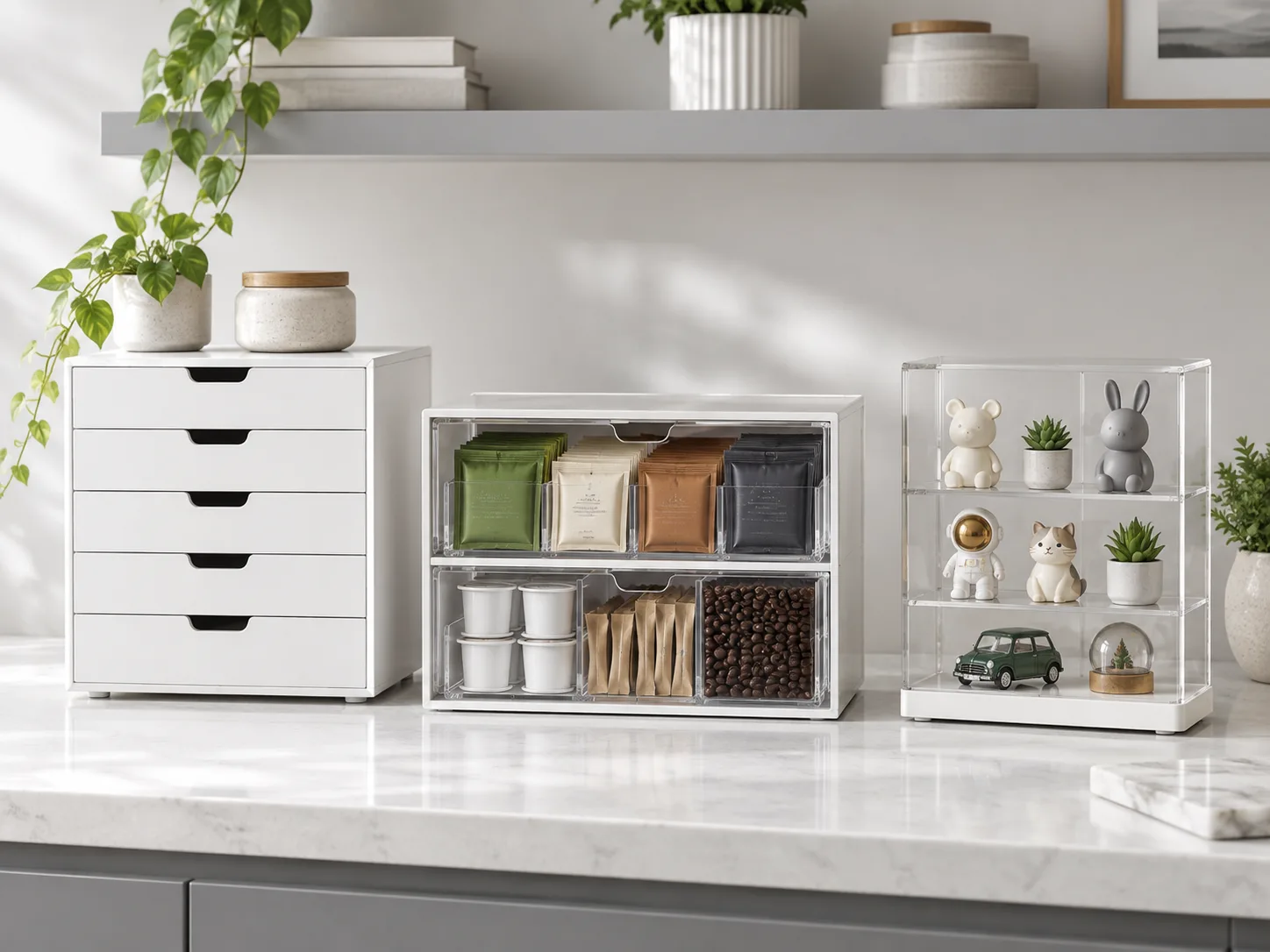
The HAKORA Countertop & Display Organizers range provides a practical starting point for a tiered retail offer. The examples below describe catalogue formats; final dimensions, materials, colors, accessories and packing should always be confirmed against the approved sample and current quotation.
| Assortment role | Example format | Buyer review point |
|---|---|---|
| Compact daily station | Tea and coffee organizer, SKU 1155; listed size 13.8 × 17 × 25 cm | Check the base footprint and the vertical clearance where it will be used. |
| Larger divided station | Four-compartment covered organizer, SKU 1156; listed size 27 × 17 × 25 cm | Check whether dividers and access match the intended packets or small items. |
| Display-led companion | Cup organizers, SKUs 1131 and 1132, with arch-door and flat-door options | Check door operation, visible finish and the contents shown in photography. |
This is a starting assortment, not a recommendation to stock every variation. A retailer can first test one compact organizer and one larger or display-led companion, then expand the range using sell-through, returns and customer questions from its own channel. A clear product hierarchy is more useful than several near-identical SKUs competing for the same shelf space.
3. Check fit in a real kitchen setting
Countertop products are judged in context. A 25 cm-tall organizer may fit the product photograph but conflict with an upper cabinet, appliance or backsplash in a customer's kitchen. A covered format also needs room to open and remove contents.
For each sample, record the base dimensions, total height, opening direction, clearance needed for access and usable internal space. Place it next to representative appliances, then repeat the check beneath a cabinet. Photograph both a tidy everyday setup and the fully opened product. If the product is intended for a shelf as well as a countertop, test both positions rather than assuming the same image and copy will work for each.
Ask the supplier to confirm exactly which measurements include handles, hinges, lids or feet. Product-page dimensions should describe the shipped item accurately. If the retail pack shows tea bags, pods or cups, make clear whether those are illustrative props or included contents.
4. Review visibility, material and care claims together
Clear panels can help shoppers identify stored items, but the sample should be reviewed under the lighting and handling conditions of the intended channel. Look for haze, visible scratches, color consistency, fit between opaque and clear parts, lid or door alignment, and edges that will be touched during normal use.
HAKORA's listed tea and coffee formats use combinations of PET, ABS and, for some models, GPPS. The cup display formats also use these materials. Material names are useful specification inputs; they are not by themselves evidence that a finished item is food-contact approved, dishwasher-safe, heat-resistant or suitable for every market. If the intended use requires any such claim, agree on the exact product, test method, documents and market requirements before printing it on packaging or publishing it online.
Care instructions deserve the same review. Buyers should request guidance for cleaning the complete assembled product, including joints and clear surfaces, and compare it with the way consumers are likely to use the item. Remove claims that cannot be supported for the approved SKU.
5. Make the online and in-store story consistent
A countertop organizer often needs only a few images to explain itself well: a straight product view, a realistic kitchen application, an open or access view, and a dimension graphic. Use the same approved variant across photography, specification sheets and retail packaging.
For e-commerce, the first image should identify the actual included product. Later images can show possible uses, but should not imply that a kettle, coffee machine, cups or consumables come in the box. On a physical shelf, the product name and front-of-pack image should make the capacity and opening style understandable without a long paragraph.
When planning colors or a private-label collection, decide which items share the same visual system. A coordinated compact organizer and display unit can be easier to merchandise together than two products that merely use a similar material. HAKORA's OEM & ODM process can be used to discuss color, packaging and brand-facing details once the functional range is clear.
6. Approve packaging with the physical sample
Countertop products are small enough to ship in high volumes but often have visible surfaces that reveal scuffs or poor alignment immediately. Ask to review a factory-packed sample, not only an unpacked product. Check the protection around clear parts, movement inside the carton, the orientation of a door or lid, and whether labels or printed inserts contact display surfaces.
For a quotation and approval checklist, request:
- The final SKU list, color direction and approved reference samples.
- Product and retail-pack dimensions, weights and carton quantities.
- Photographs of the packed item, inner protection and master carton.
- Barcode, country-of-origin and market-specific labeling requirements.
- A sample review of opening, closing, appearance and pack-out after transit testing agreed for the program.
- MOQ and lead-time confirmation for the exact combination of SKUs and customization requested.
Avoid assuming the same pack-out works for both a compact covered organizer and a clear-front display unit. Their vulnerable surfaces and retail presentation may differ. Align inspection criteria with the approved sample and packaging artwork before production is complete.
A concise brief to send a supplier
If you are considering a tea and coffee organizer wholesale range, send the intended sales market, channel, target shopper, countertop setting, desired number of SKUs, preferred sizes, opening style, color direction, packaging format and any claims you expect to make. Include the target launch window and forecast quantity if available. A clear brief makes sample and quotation discussions more useful than a request for a generic catalogue price.
Discuss a countertop organizer range with HAKORA →
FAQ
What should a retailer check before buying countertop organizers wholesale?
Confirm the actual footprint, height and opening clearance; inspect the surface finish and moving parts; compare packaging with the approved sample; and verify that product-page claims and photographs match the item supplied. Ask for the exact SKU and customization scope behind each quotation.
Should tea and coffee organizers be sold as a set?
A set can make sense when its pieces serve clearly different jobs and its combined footprint suits the target kitchen. Start by testing the customer proposition and pack-out. Individual SKUs may be easier for shoppers who have limited counter space or already own one part of a drink station.
Can a clear organizer be described as food-safe or dishwasher-safe?
Only when the claim is supported for the exact finished product and intended market. A resin description alone does not establish food-contact or dishwasher performance. Review the required evidence and approved care instructions before using either phrase.
Conclusion
The strongest countertop assortment does more than hide clutter. It gives each item a specific storage mission, fits a real kitchen, and presents the delivered product honestly. Recent research explains why this category deserves attention; sample checks, clear SKU roles and packaging approval determine whether the range works in retail practice.