
PRODUCT SOURCING 9 min read
Small Collectible Display Cases: A Retail Buyer's Guide to Fit, Materials and Packaging
Choose small collectible display cases for retail: compare usable dimensions, door access, clear plastics, sample quality and packaging before sourcing.
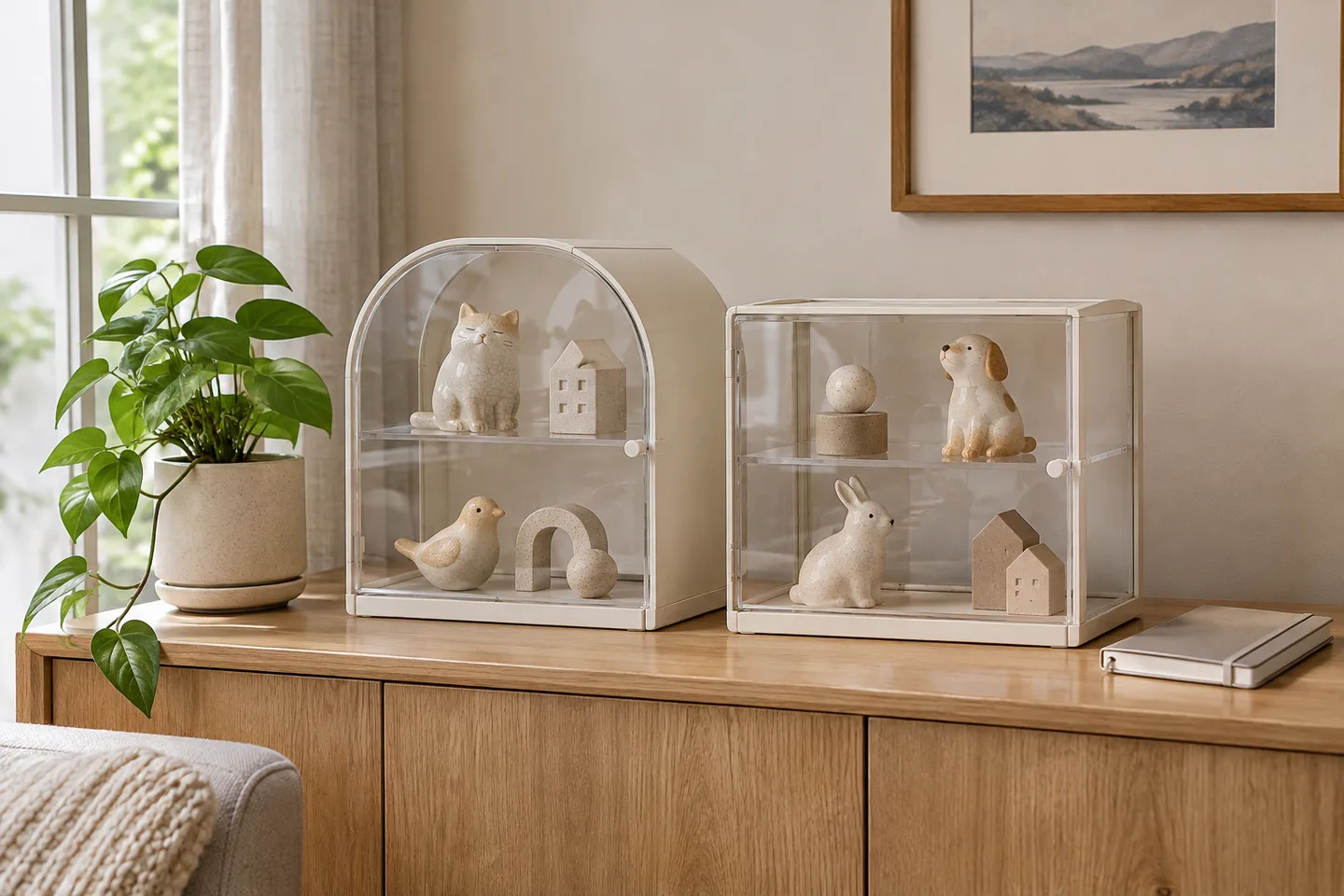
AI-generated lifestyle illustration. The boxes and contents illustrate a display setting and do not represent exact HAKORA products or included accessories.
Small collections rarely stay small in the same way. A shopper may begin with a few miniature figures, then add a taller ceramic piece, a model with a base or a keepsake with an awkward outline. A display box that looks right in a photograph can become frustrating if its door catches an object or its shelf leaves too little headroom.
For retailers, importers and private-label buyers, that makes selection a practical exercise in fit and presentation. This guide explains how to assess compact display cases, build a useful range and prepare a sourcing brief around the items customers actually keep.
Why collectible display deserves a separate product brief
In its August 12, 2026 U.S. toy-market report, Circana reported that toy sales for adult recipients aged 18 and over grew 25% in the first half of 2026 compared with the same period a year earlier. It also identified continuing interest in collectibles and hobby-oriented play.
Those findings describe the U.S. toy market, not sales of display boxes. They nevertheless give buyers a reason to investigate how collectors arrange and access their objects at home. The commercial opportunity for a storage range is a hypothesis to test with your customers, rather than a growth rate to copy onto a display-case listing.
A collectible organizer has a different job from a tea organizer, even when the two share a countertop footprint. The display product needs to frame the objects clearly, leave space around irregular shapes and permit access without disturbing the whole arrangement. Keep that brief separate from the tea and coffee organizer assortment.
1. Measure usable space before comparing capacity
Start with a representative group of objects from the intended category. Measure them in their display position, including a stand, extended accessory or raised feature. A nominal figure height does not account for the complete pose.
Separate three sets of measurements
- Outside footprint: The space the closed case occupies on a shelf or countertop.
- Usable interior: The clear width, depth and height available after allowing for frames, shelves, hinges and other intrusions.
- Access envelope: The additional room needed to open the door, lift a cover and move an object through the opening.
Record all three. If a supplier provides only external dimensions, request the missing measurements before describing compatible objects or a maximum figure count.
For example, a case listed as 25 cm wide is not necessarily suitable for an arrangement that is 25 cm wide. Wall thickness, the door opening and internal components can all reduce the space available. Avoid a universal clearance allowance: fragile protrusions, object shape and the way the user reaches inside affect the gap needed.
Build a fit table for the proposed range
| Measurement or observation | Why it matters | What to confirm on the sample |
|---|---|---|
| Interior width and depth | Objects may fit individually but not as a group | Arrange representative objects without touching the walls |
| Clear height at each position | An arch or shelf can restrict tall pieces | Check the tallest object where it will actually stand |
| Door opening and swing | A case can fit a shelf while its door cannot open | Open it in the intended shelf position |
| Base and any internal shelf | An uneven support can make objects unstable | Check level seating and the stated load limits |
| Hand access | Rear objects may be hard to reposition | Remove and replace an item without moving its neighbors |
2. Compare tabletop, covered and wall display formats
Choose formats according to the display setting. A compact tabletop box may suit a desk or sideboard; a wall format can free a horizontal surface, but adds mounting and installation questions.
| Format | Useful when | Buying questions |
|---|---|---|
| Front-opening tabletop box | The collection changes regularly | Can the door open fully without striking neighboring items? |
| Lift-off covered box | The arrangement is handled less often | Is there enough overhead room to remove the cover? |
| Open display | Frequent rearrangement matters most | How will the buyer explain cleaning and exposure? |
| Wall-mounted display | Counter space is limited | What wall types, fixings and installation instructions are supported? |
A closed door can help limit everyday dust exposure, but closed does not automatically mean dustproof or airtight. Check gaps around the door and joints, then agree on wording that the product evidence supports. Likewise, do not photograph cases stacked or hanging unless the exact configuration is approved for that use.
3. Use real catalog examples without assuming compatibility
HAKORA's Countertop & Display Organizers include arch-door and flat-door cup and collectible organizers. Catalog references 1131 and 1132 list external dimensions of 25 × 17.2 × 24.8 cm and a material combination of PET, ABS and GPPS.
These are starting references for a product discussion. They do not establish usable compartment dimensions, compatibility with a named collectible range or a tested protection rating. Review the 1131 arch-door catalog sample and 1132 flat-door sample, then ask for the interior measurements and access details relevant to your assortment.
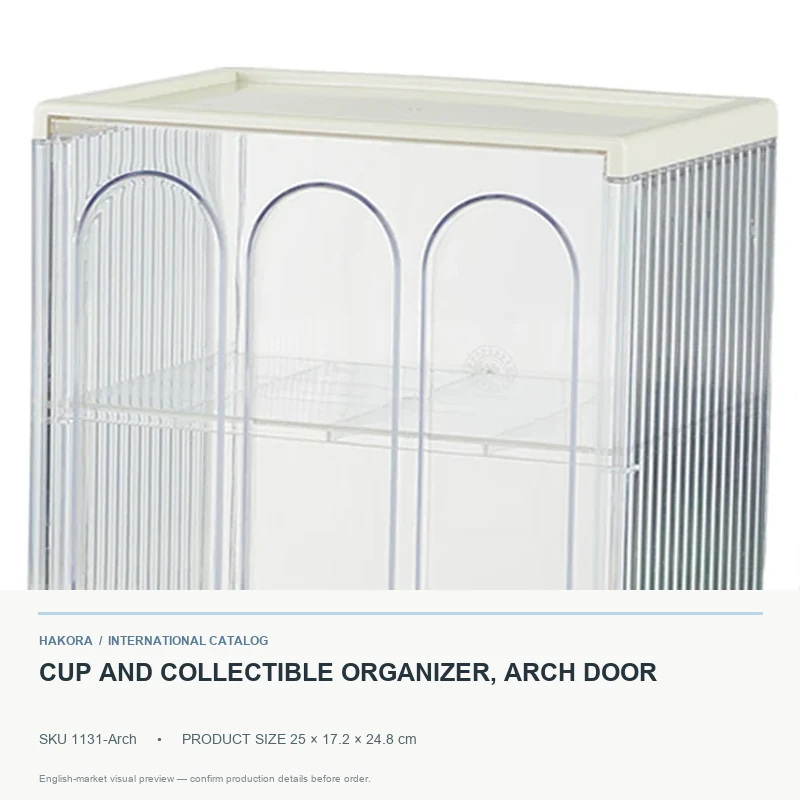
The arch and flat front also provide a useful comparison exercise: place the same representative objects in each sample and assess the view and access. Do not infer that one holds more from its outline alone.
4. Specify the components rather than asking for acrylic by default
Search results often use acrylic as shorthand for a transparent display case. Clear appearance does not identify a resin, and HAKORA's listed 1131 and 1132 references are multi-material products rather than all-acrylic boxes.
Ask the supplier to identify the body, clear panel, frame, door hardware and any removable insert separately. This makes the quotation, product description and care instructions easier to review. The PP vs PET vs ABS material guide provides broader sourcing context; the approved bill of materials should describe the actual item being ordered.
Inspect what the shopper will see
View the sample from the front and sides under normal indoor lighting. Look for haze, distracting reflections, distortion, visible flow marks and scratches. Check color consistency between opaque components and whether the door sits evenly against its frame.
Request care instructions for the complete assembly. Do not assume that a cleaner suitable for one component is suitable for all of them. If UV filtering matters to your customer, ask for a defined claim and supporting test information for the finished product. Transparency alone does not establish UV protection, and a display case is not a controlled conservation environment.
5. Make sample approval reflect everyday use
A brief sample review should cover both presentation and handling. Agree on the assessment method and acceptance criteria with the supplier before using the sample as a production reference.
- Set it up: Check the supplied parts, assembly instructions and orientation of any removable components.
- Try the collection: Photograph the intended arrangement and note usable clearances.
- Use the opening: Open and close it repeatedly using the agreed review procedure; inspect catches, alignment and rubbing surfaces.
- Check the support: Review the base, shelf seating and stability in the intended placement, using confirmed limits.
- Inspect the finish: Examine clear and opaque parts before and after normal handling.
- Record the result: Keep approved images, measurements, component details and unresolved issues together.
Do not invent a cycle count or load claim for the listing. If those performance statements are required, define the test conditions and evidence before publication.
6. Protect transparent parts through packing and delivery
Clear panels make marks easy to notice. Review whether a handle, loose component or packing insert can rub against them during transport. Open a packed sample as a customer would and check the condition of the visible surfaces.
HAKORA's catalog lists a PE bag and master carton for the 1131/1132 series. That is a reference packing description, not evidence of parcel-shipping performance. If the item will be sold online, discuss the individual pack, outer shipping carton, component restraint and the validation appropriate to the route.
The packaging brief should also distinguish the case from the objects shown inside it. Agree on included parts, assembly requirements, measurements, barcode placement and care information. A styled photograph should not imply that figurines, risers or accessories are supplied unless they are included in the approved SKU.
7. Build a focused retail assortment and quotation request
Give each SKU a role customers can understand. One format might prioritize a compact footprint; another might offer a different opening or front shape. Base these roles on verified differences, rather than creating many color variants before establishing fit.
For initial buying discussions, send:
- The target country, retail channel and intended customer.
- Photographs and dimensions of representative collectibles, including stands and accessories.
- Available shelf space and the preferred opening method.
- Desired product mix, color direction and branding requirements.
- Individual packing and delivery-route requirements.
- Expected quantity, launch timing and any performance claims that need evidence.
HAKORA can use that information to discuss relevant catalog formats and OEM & ODM options. Availability, customization, sample arrangements, MOQ and timing should be confirmed for the proposed program.
Planning a collectible display range? Send your product and packaging requirements to HAKORA. Include the objects you want the case to hold so the discussion can begin with usable space and access.
Frequently asked questions
What size display case do I need for small collectibles?
Measure the objects in their intended pose, including bases and accessories. Compare those measurements with the usable interior and door opening, then allow enough room for safe handling. Outside case dimensions alone are insufficient.
Are small collectible display cases always acrylic?
No. Clear display products can use different plastics and combinations of materials. Ask for a component-level specification. HAKORA's 1131 and 1132 catalog references list PET, ABS and GPPS.
Does a clear display box protect collectibles from UV light?
A clear appearance does not prove UV filtering. Request product-specific evidence for any UV claim and follow the collectible maker's display and care advice. Avoid assuming that an enclosure makes direct sunlight harmless.
Can the same case hold figurines and collectible cups?
Possibly, but check the actual objects. Handles, bases, unusual shapes and the door opening can affect fit. A successful sample arrangement is more useful than a generic capacity claim.
What should a wholesale buyer request before ordering?
Request component materials, external and internal dimensions, included parts, care instructions, sample arrangements, packing details and confirmation of quotation terms. Agree on the sample approval record and any required performance evidence.
A better display range starts with the objects inside
The most useful small collectible display cases make an arrangement easy to see, reach and maintain. For a retail buyer, that means measuring usable space, reviewing the complete sample and keeping product claims aligned with the evidence. A clear brief then connects the display setting to a product, a packing plan and a more productive supplier conversation.