
BUYER'S GUIDE 9 min read
Home Office Organization in 2027: A Retail Buyer’s Guide to Desk and Drawer Storage
Plan a home office organization range with practical desk and drawer storage. Compare product roles, assortment gaps, dimensions and sourcing checks for 2027.
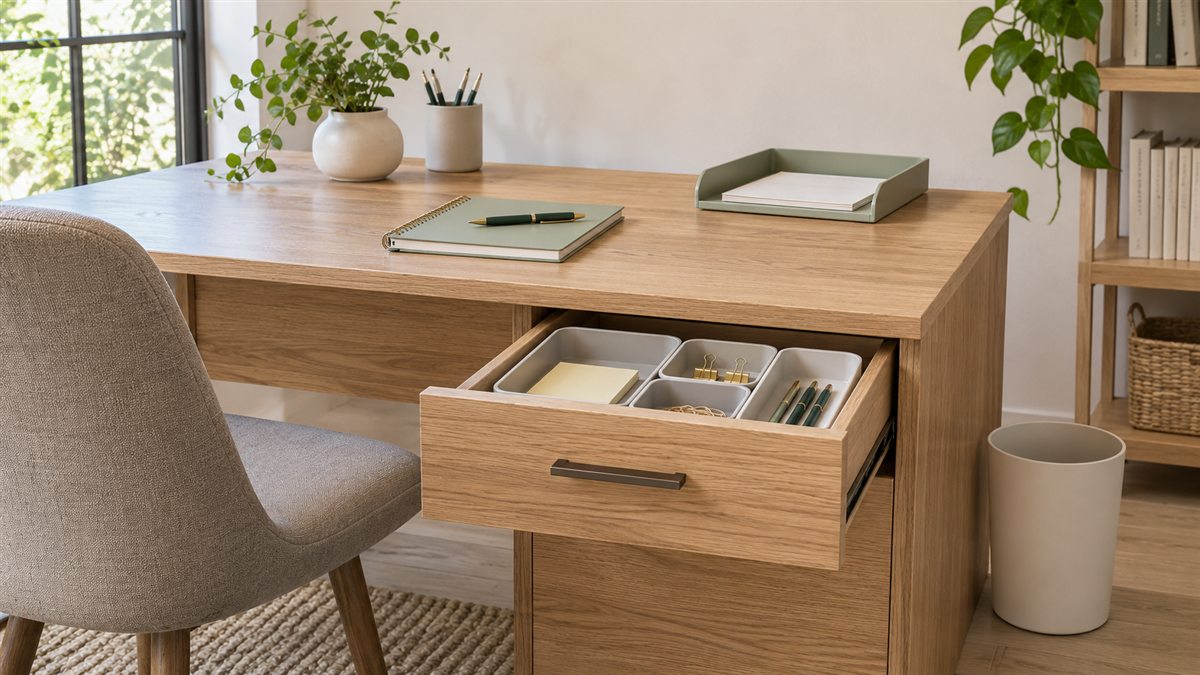
AI-generated editorial illustration. Generic desk and drawer setting; not an exact HAKORA product photo or customer installation.
Home office organization is not one product problem. Some shoppers want a clear work surface; others need small items separated inside a drawer or a place for everyday desk waste. For retail buyers, the opportunity is to make those jobs easy to understand and combine—without building an assortment of near-identical SKUs that compete for the same shelf space.
For 2027 range planning, start with the shopper task, then check the product footprint, use context, pack format and supplier evidence. A “home office” label alone does not tell a buyer which storage formats belong in the range or whether a product will fit the furniture customers already own.
Why desk and drawer storage belongs in the 2027 planning conversation
The 2026 International Housewares Association (IHA) MarketOutlook survey reports purchase intent of 19% for desk organizers and 20% for file and drawer storage within its Home Storage & Organization category. The survey was conducted by Morning Consult among 2,201 adults. These figures are a useful directional signal for category planning, not a forecast of 2027 sales or a guarantee for any retailer, region or specific product. Read the IHA 2026 MarketOutlook methodology and category findings.
For buyers, the practical takeaway is to treat desk and drawer storage as related but separate missions. A tray on the desk competes for visible surface space. An organizer inside a drawer must fit the furniture and stored items. A desktop waste bin has a different function again. Keeping those roles distinct makes product pages, packaging and merchandising easier to shop.
Map the assortment to three shopper jobs
Before reviewing individual samples, define the range around where the product will be used and what the shopper expects it to hold.
| Shopper job | Potential product role | Buyer checks |
|---|---|---|
| Keep frequently used items within reach | Desktop tray or compact accessory, if offered in the supplier’s verified range | Surface footprint, compartment layout, stability and what is included |
| Separate small items inside a desk drawer | Shallow, deep or expandable drawer organizer | Internal drawer dimensions, usable footprint, height clearance and compatibility between pieces |
| Collect small everyday desk waste | Compact desktop waste bin | Opening, capacity, liner or inner-bin arrangement, cleaning instructions and pack presentation |
This is an assortment framework, not a claim that every supplier offers every format. HAKORA’s currently listed pages show desktop waste-bin options and drawer/cabinet organizers, including shallow, deep and expandable formats. The published range does not by itself confirm monitor risers, cable-management systems, file holders or other desk accessories. Verify each proposed SKU and its exact specifications before including it in a buyer presentation.
Build a focused assortment instead of a long SKU list
A useful opening range usually gives each item a distinct reason to exist. Start with a small core that covers the most common jobs, then add supporting options only when they solve a clear fit, access or merchandising need.
1. Choose the core by function
Separate the desktop and drawer plans. For the desktop, ask whether a product keeps often-used items organized, collects waste or serves another verified function. For drawers, decide whether the range needs low-profile trays, deeper compartments or an adjustable footprint. Do not treat one product as a substitute for another just because both sit near a desk.
2. Use size steps shoppers can compare
For drawer organizers, use a size ladder only when the differences are clear in actual use. Record external dimensions and, where relevant, usable internal dimensions. Note whether pieces can sit side by side, whether heights interfere with closing the drawer, and whether an expandable product has defined closed and extended measurements.
For desktop items, compare the footprint against the space available beside a laptop or notebook. A larger capacity is not automatically a better choice if it takes too much of the work surface. Ask for images or drawings with a common scale so that the buyer can compare proportions across the range.
3. Keep color and finish intentional
Color variants can make a collection feel coordinated, but they do not replace functional variety. The currently listed HAKORA desktop waste-bin family, for example, presents several color options for one compact format. A retailer can evaluate that as a color-led choice, while planning drawer products separately around their size and storage roles.
If a program includes multiple colors, confirm which components change, how color references are controlled between samples and production, and whether the packaging communicates the correct variant. Avoid presenting color choices as different capacities or functions when the product specifications do not support that distinction.
Validate the product in the furniture it is meant to serve
Desk and drawer organizers are highly dependent on fit. A sample on a showroom table may look suitable but still be too wide, too tall or awkward to use in a real drawer. Before approving a range, test representative samples in the intended setting.
- Measure the drawer’s internal width, depth and usable height; include runners, handles and other obstructions.
- Place the organizer in the drawer and check that it opens and closes normally.
- Add representative contents and check whether they remain easy to reach.
- Test adjoining trays together instead of assessing each size in isolation.
- For expandable formats, record the closed and extended dimensions and check both positions.
- Photograph the setup and note the sample revision so product, sourcing and marketing teams review the same version.
For desktop accessories, repeat the review on a compact work surface and a larger desk. Check that the item can be reached without blocking the work area, and confirm the way it is emptied or cleaned from the supplier’s instructions. Do not make durability, safety or performance claims based on appearance alone.
Ask suppliers for information that makes the range sellable
An assortment is not ready for a buyer review when it contains only a product name and a lifestyle image. Ask for a SKU-level data sheet and sample evidence that merchandising and operations can use.
- External dimensions, usable internal dimensions where relevant, and product weight.
- Material by component, available color references and clear photographs of the actual sample.
- Included pieces, set quantity, assembly steps and care or cleaning guidance.
- Retail-pack dimensions, pack contents, barcode position and master-carton details.
- Minimum order quantity, lead-time assumptions and price validity for the specific SKU.
- Sample revision, approval record and any destination-market documentation required for the product.
Confirm commercial details directly with the supplier; they can vary by SKU, packaging, destination and order plan. If a capability or document has not been confirmed, mark it as pending rather than adding it to a product page or sales sheet.
Connect the blog topic to product discovery
Searchers looking for home office organization products may use broad terms, but a retail buyer needs to move from the broad category to a specific product role. Use one clear home-office guide as the entry point, then link to relevant category pages such as desktop organization and drawer and cabinet organizers. The drawer organizer size guide can support the fit discussion, while the materials guide helps frame material questions.
On product pages, make the information useful to both people and search engines: a unique title and description, one clear H1, scannable headings, descriptive image alt text and verified specifications. Link only to products that are available in the current catalog, and keep each page focused on its own product family rather than repeating the same general “home organization” copy everywhere.
A practical 2027 buyer checklist
Before adding a desk or drawer storage SKU to a seasonal or core assortment, confirm:
- The shopper job and room placement are specific.
- The item has a distinct function or a clear size/color role in the collection.
- Representative furniture and contents have been used to validate fit.
- Dimensions, material, components and pack contents are documented for the exact SKU.
- Product photography matches the approved sample; illustrative images are labeled as illustrations.
- Retail packaging answers the shopper’s basic questions without unsupported claims.
- MOQ, price, lead time and required documents are confirmed with the supplier.
- Related products and buyer guides create a clear route from discovery to inquiry.
Frequently asked questions
What should a home office organization assortment include?
Begin with products that address distinct jobs, such as desktop storage, drawer separation and desktop waste collection. Choose formats based on your customer, price architecture and verified supplier catalog; do not assume every supplier offers every accessory type.
How do retail buyers choose desk drawer organizer sizes?
Start with the inside measurements of representative drawers, including usable height and any obstructions. Test samples with realistic contents and check whether multiple pieces work together without preventing the drawer from closing.
What should I request from a desk organizer supplier?
Request SKU-level dimensions, material and color details, pack contents, retail and master-carton information, sample photos, MOQ, lead-time and pricing assumptions, and any documents required for your market. Confirm the final details for each SKU before approving the range.
Are the images on this page exact HAKORA products?
No. The cover is an AI-generated editorial illustration of a generic home-office setting. It is not an exact product photograph, customer installation or evidence of product performance. Refer to the linked product pages and approved samples for current product details.
Planning a desk and drawer storage range? [Share your target market, preferred product roles and sourcing requirements with HAKORA](/contact).